AI/ML

Computer Vision

Language and vision are fundamentally different

Language

a mind one word after another →
Generated by the human brainWe invented it: symbols that mean something only because people agree they do.
One-dimensionalA single line of words, sounds or characters.
SequentialOrder carries meaning: "dog bites man" is not "man bites dog".

Vision

the real world a whole image at once
Not generated: a phenomenon of the real worldLight bounces off things into an eye or a camera. Nobody wrote it.
Two-dimensionalA flat grid of pixels: a 2-D picture of a 3-D world.
Spatial, all at onceEvery pixel arrives together; what matters is what sits next to what.

So language models learn what people produced; vision models must learn how the world looks.

Fundamentals

Basics

Image Representation Color Spaces Pixel Operations Image Filtering Kernels & Convolution Edge Detection Image Transforms Noise & Blurring
Fundamentals

Features

Feature Detection Feature Descriptors SIFT & SURF ORB Features Keypoint Matching Feature Extraction
Intermediate

Transforms

Geometric Transforms Perspective Transform Morphological Operations Image Segmentation Region Processing
Intermediate

Advanced filters

Bilateral Filteringcoming soon
Median Filteringcoming soon
Guided Filteringcoming soon
Adaptive Filterscoming soon
Advanced

Object detection

Sliding Windowcoming soon
Cascade Classifierscoming soon
Region Proposalscoming soon
YOLO Basicscoming soon
R-CNN Familycoming soon
Advanced

Segmentation

FCN Networkscoming soon
U-Net Architecturecoming soon
DeepLabcoming soon
Mask R-CNNcoming soon
Advanced

Applications

Face Detectioncoming soon
Pose Estimationcoming soon
3D Visioncoming soon
Resources

Textbook

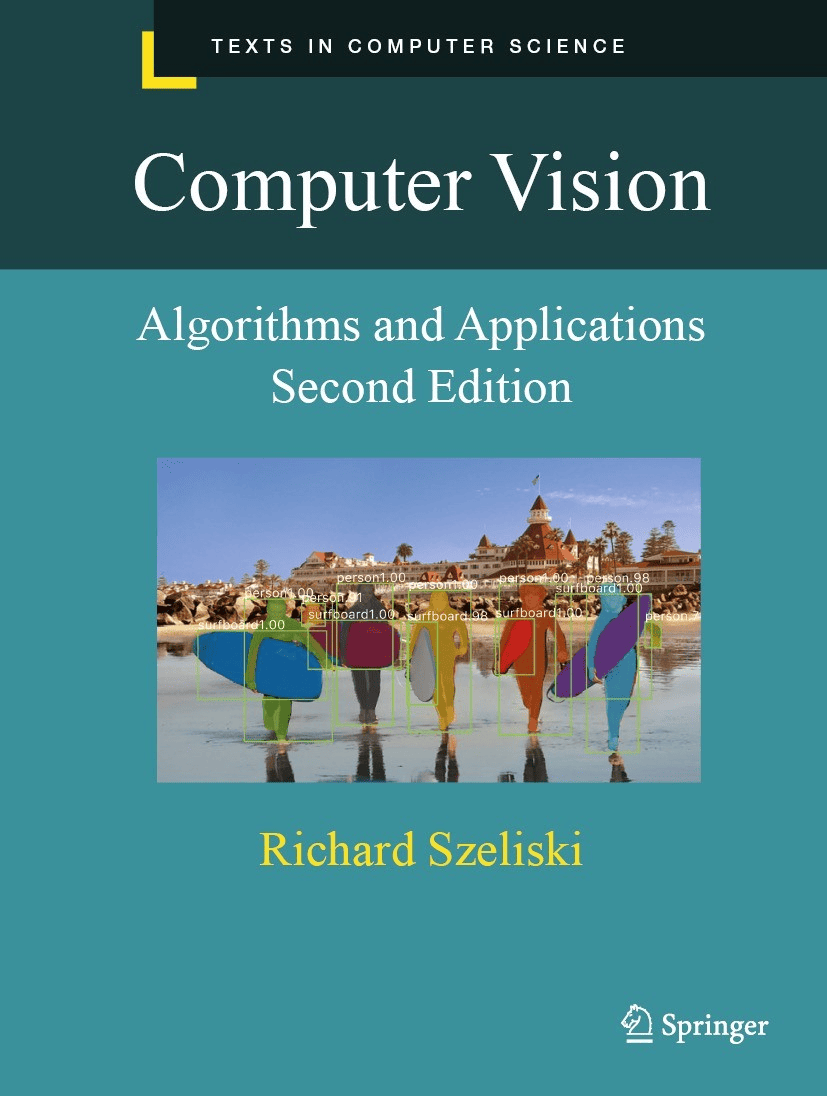
Cover of Computer Vision: Algorithms and Applications, second edition, by Richard Szeliski

Richard Szeliski, Computer Vision: Algorithms and Applications, 2nd edition.
Free access to the book