The same four pictures, by hand
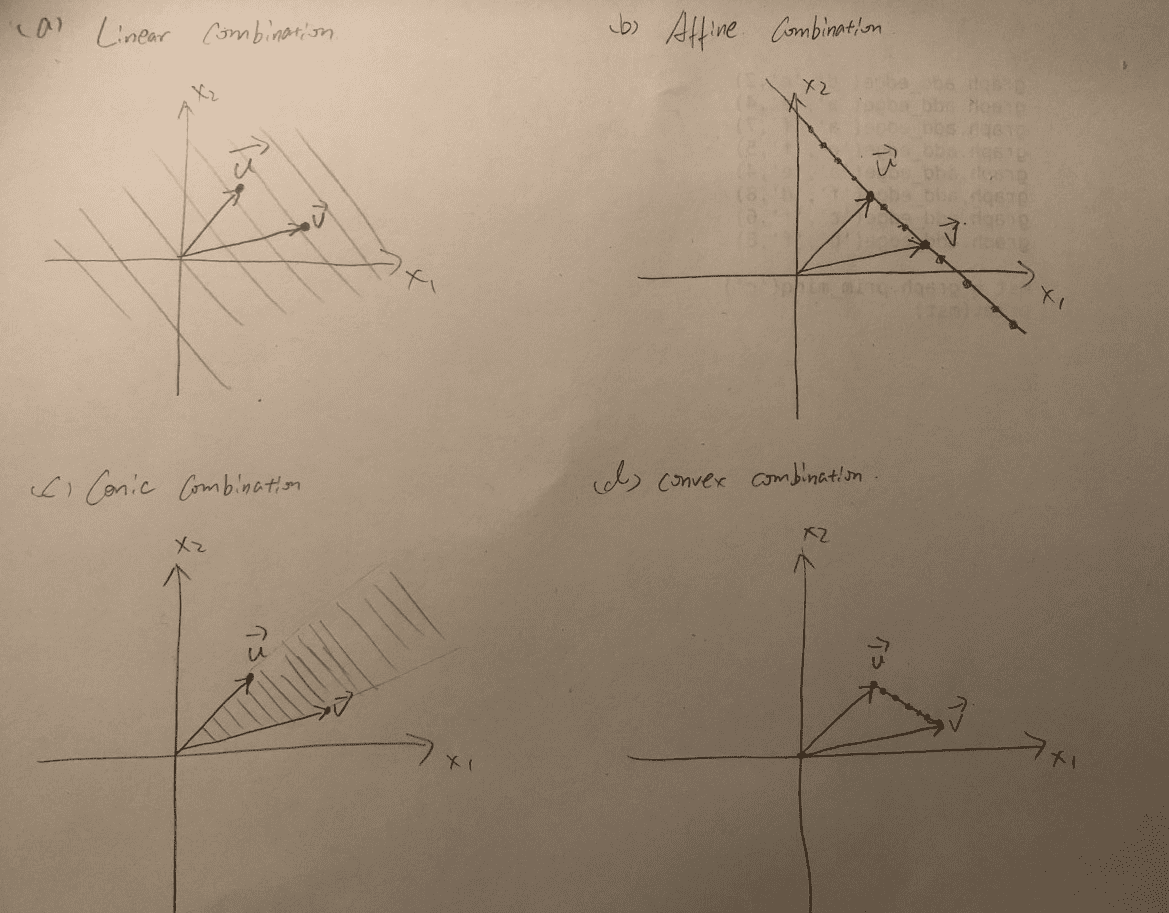
Four ways to combine vectors \(a\mathbf{u} + b\mathbf{v}\): the only difference is which coefficients you allow.
A combination of vectors is \( a_1\mathbf{x}_1 + a_2\mathbf{x}_2 + \dots + a_n\mathbf{x}_n \).
| Type of combination | Restriction on coefficients | Name of set | Model space |
|---|---|---|---|
| Linear | no restrictions | Vector subspace | \( \mathbb{R}^n \) |
| Affine | \( \sum a_i = 1 \) | Affine subspace | Affine hyperplane |
| Conical | \( a_i \ge 0 \) | Convex cone | Quadrant, octant, or orthant |
| Convex | \( a_i \ge 0 \) and \( \sum a_i = 1 \) | Convex set | Simplex |
Linear map \( f(\mathbf{x}) = A\mathbf{x} \)
Grid lines stay straight and evenly spaced; the origin stays put.
Affine map \( f(\mathbf{x}) = A\mathbf{x} + \mathbf{b} \)
A linear map followed by a shift: the origin moves.
Affine maps keep affine combinations: the midpoint of a segment still lands on the midpoint.